> ## Documentation Index
> Fetch the complete documentation index at: https://docs.triplesession.com/llms.txt
> Use this file to discover all available pages before exploring further.
# Send Meeting Notes and Update Properties on HubSpot Tickets
> Use Automations to add AI Coach meeting notes to an open HubSpot ticket and to fill ticket properties automatically after a call ends.
If your CS or Support team works out of HubSpot tickets, Automations can write to the ticket that a call was actually about. There are two ways to do it, and both can run in the same automation:
* **Send notes to ticket** — adds the meeting notes AI Coach already generates as a note on an open ticket.
* **Update CRM with Ticket as the object type** — fills ticket properties from scorecard results and deal insights, using the same field mapping you already use for deals and contacts.
Both find the right ticket the same way, so once you have configured one you know how to configure the other.
## Requirements
* Your account must have access to [Automations](/automations/getting-started).
* HubSpot must be connected with **Tickets** access granted. See [Connect HubSpot](/crm/connect-hubspot).
* Tickets are available on **Meeting Finished** automations.
Tickets are supported for HubSpot only. Salesforce Cases are not supported.
If Tickets are unavailable, the options stay visible in the builder with the reason:
* **Connect HubSpot to use Ticket automations** — no HubSpot connection on the workspace.
* **Reconnect HubSpot and grant Tickets access** — HubSpot is connected, but it was authorized without access to tickets. Reconnect it from **Settings > CRM** and approve tickets.
## How the right ticket is chosen
A customer can have several tickets, and more than one may be open at the same time. Two settings, shown on both ticket actions, decide which one gets written to.
### Ticket resolution path
This tells Triple Session where to start looking. Triple Session takes the CRM records already matched to the call, then follows their ticket associations in HubSpot.
| Option | What it looks at |
| --------------------------------- | ------------------------------------------------------------------------- |
| **All standard objects → Ticket** | Tickets associated with any company, contact, or deal matched to the call |
| **Contact → Ticket** | Tickets associated with the matched contacts only |
| **Company → Ticket** | Tickets associated with the matched companies only |
| **Deal → Ticket** | Tickets associated with the matched deals only |
Pick the narrowest path that reliably reaches your tickets. If every ticket in your portal is associated with a contact, **Contact → Ticket** is the most predictable choice. Use **All standard objects → Ticket** when tickets are attached inconsistently.
Only **open** tickets are considered. Closed tickets are never written to, and Triple Session never creates a ticket — if nothing open is found, the action is skipped.
### When several open tickets match
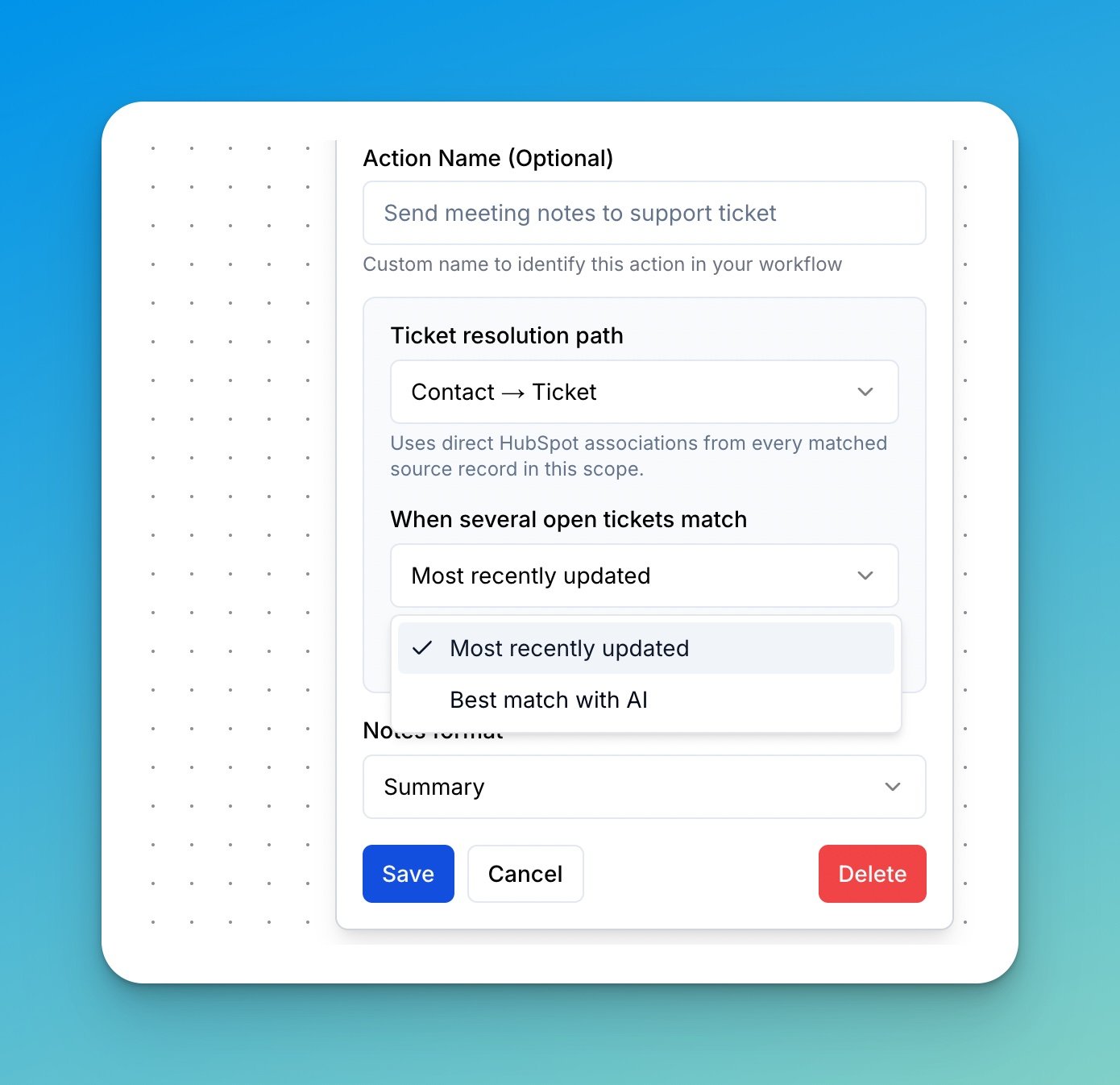 * **Most recently updated** — picks the open ticket that was updated most recently. Always writes when there is at least one open ticket. Start here.
* **Best match with AI** — compares the conversation against the open tickets and picks the one it is about. If the call does not clearly point to a single ticket, the action is skipped rather than guessing.
If only one open ticket is found, it is used regardless of which option you choose.
## Send meeting notes to a ticket
Go to **Settings > Automations**, open or create a **Meeting Finished** automation, then click **Add Action** and choose **Send notes to ticket**.
Optionally give the action a name — for example, *Send meeting notes to support ticket* — to identify it in the workflow.
Set the **Ticket resolution path** and **When several open tickets match**, as described above.
* **Most recently updated** — picks the open ticket that was updated most recently. Always writes when there is at least one open ticket. Start here.
* **Best match with AI** — compares the conversation against the open tickets and picks the one it is about. If the call does not clearly point to a single ticket, the action is skipped rather than guessing.
If only one open ticket is found, it is used regardless of which option you choose.
## Send meeting notes to a ticket
Go to **Settings > Automations**, open or create a **Meeting Finished** automation, then click **Add Action** and choose **Send notes to ticket**.
Optionally give the action a name — for example, *Send meeting notes to support ticket* — to identify it in the workflow.
Set the **Ticket resolution path** and **When several open tickets match**, as described above.
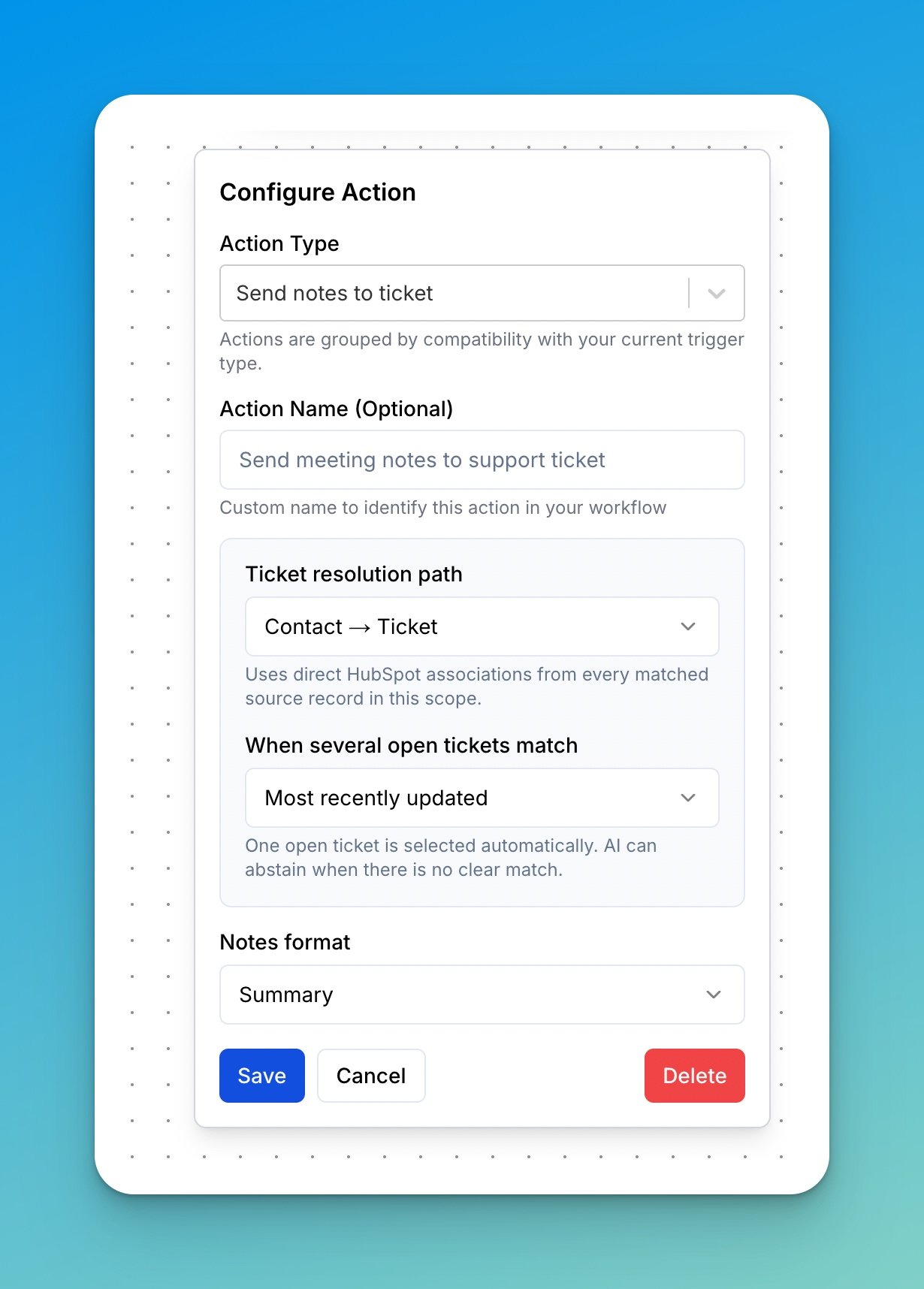 Pick what the note contains:
* **Summary** — the meeting summary.
* **Deal Insights** — the insights extracted from the conversation.
* **Summary + Deal Insights** — both.
This is the same content produced by the note push in **Settings > AI Coach > CRM**, but this action is configured on its own. It runs even if automatic note push is turned off, and it does not change those settings.
Click **Save**, then set the automation status to **Live**.
## Update ticket properties
In your **Meeting Finished** automation, click **Add Action** and choose **Update CRM**.
Choose the scorecard whose results should fill the ticket, then set **Object Type** to **Ticket**.
The ticket settings appear below it: set the **Ticket resolution path** and **When several open tickets match**.
Pick what the note contains:
* **Summary** — the meeting summary.
* **Deal Insights** — the insights extracted from the conversation.
* **Summary + Deal Insights** — both.
This is the same content produced by the note push in **Settings > AI Coach > CRM**, but this action is configured on its own. It runs even if automatic note push is turned off, and it does not change those settings.
Click **Save**, then set the automation status to **Live**.
## Update ticket properties
In your **Meeting Finished** automation, click **Add Action** and choose **Update CRM**.
Choose the scorecard whose results should fill the ticket, then set **Object Type** to **Ticket**.
The ticket settings appear below it: set the **Ticket resolution path** and **When several open tickets match**.
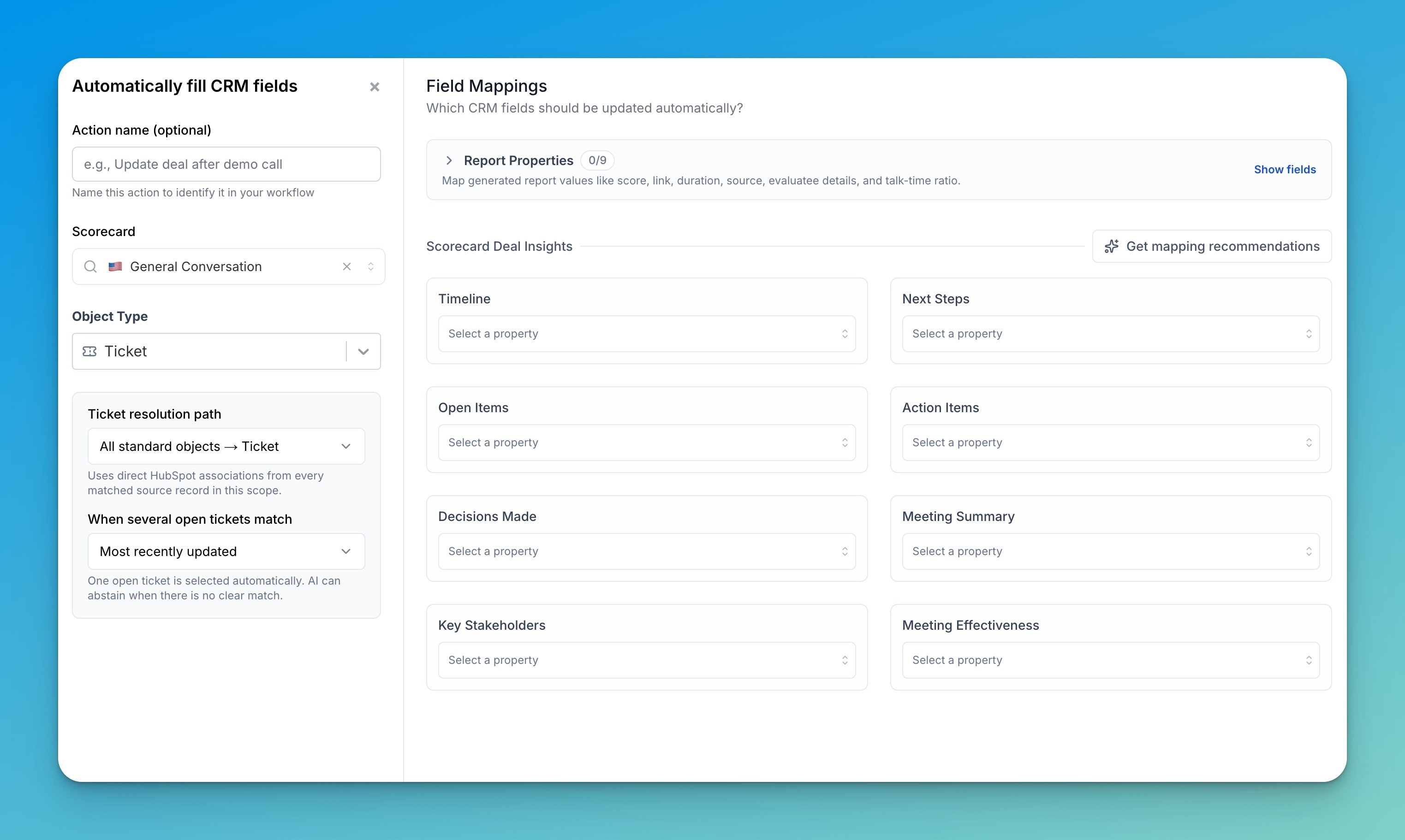 Map report properties and scorecard deal insights to HubSpot ticket properties, exactly as you would for a deal or contact. For text properties you can choose **Append** or **Replace**.
Click **Get mapping recommendations** to have Triple Session suggest matching ticket properties.
The ticket's **pipeline** and **stage** are not available for mapping. Automations fill ticket properties only — they never close, reopen, or move a ticket.
Click **Save**, then set the automation status to **Live**.
For more detail on field mapping, see [Auto-update CRM fields](/crm/auto-update-fields).
## Using both actions together
You can add **Send notes to ticket** and **Update CRM → Ticket** to the same automation. When both use the same resolution path and the same selection option, they write to the same ticket in that run, so the note and the property updates always land together.
If you deliberately configure them differently — for example, notes onto a contact's ticket and properties onto a deal's ticket — each finds its own ticket independently.
## Reading the results
Open **Logs** on the automation to see what each run did. Ticket actions report which ticket was written to, or why they were skipped:
| Result | What it means |
| ----------------------------------------- | --------------------------------------------------------------------------------------- |
| **No matching source object found** | The call was not matched to any company, contact, or deal on the configured path. |
| **No sufficiently relevant ticket found** | **Best match with AI** did not find a ticket the conversation was clearly about. |
| **Selected ticket is no longer open** | The ticket was closed between being selected and being written to. Nothing was written. |
Skips are normal and expected — they mean no ticket was a safe match, so nothing was changed in HubSpot.
After a successful write, the call is linked to the ticket in Triple Session, alongside its existing contact, company, and deal associations.
## Best practices
* **Start with Most recently updated.** It always writes when an open ticket exists, which makes it easy to confirm the automation is working before you switch to AI selection.
* **Use the narrowest resolution path that works.** Fewer candidate tickets means fewer ambiguous matches.
* **Check the logs after the first few calls.** Repeated skips usually mean the resolution path doesn't reach your tickets, or the calls aren't being matched to CRM records.
Need help setting up a specific workflow? Contact the Triple Session support team at [support@triplesession.com](mailto:support@triplesession.com).
Map report properties and scorecard deal insights to HubSpot ticket properties, exactly as you would for a deal or contact. For text properties you can choose **Append** or **Replace**.
Click **Get mapping recommendations** to have Triple Session suggest matching ticket properties.
The ticket's **pipeline** and **stage** are not available for mapping. Automations fill ticket properties only — they never close, reopen, or move a ticket.
Click **Save**, then set the automation status to **Live**.
For more detail on field mapping, see [Auto-update CRM fields](/crm/auto-update-fields).
## Using both actions together
You can add **Send notes to ticket** and **Update CRM → Ticket** to the same automation. When both use the same resolution path and the same selection option, they write to the same ticket in that run, so the note and the property updates always land together.
If you deliberately configure them differently — for example, notes onto a contact's ticket and properties onto a deal's ticket — each finds its own ticket independently.
## Reading the results
Open **Logs** on the automation to see what each run did. Ticket actions report which ticket was written to, or why they were skipped:
| Result | What it means |
| ----------------------------------------- | --------------------------------------------------------------------------------------- |
| **No matching source object found** | The call was not matched to any company, contact, or deal on the configured path. |
| **No sufficiently relevant ticket found** | **Best match with AI** did not find a ticket the conversation was clearly about. |
| **Selected ticket is no longer open** | The ticket was closed between being selected and being written to. Nothing was written. |
Skips are normal and expected — they mean no ticket was a safe match, so nothing was changed in HubSpot.
After a successful write, the call is linked to the ticket in Triple Session, alongside its existing contact, company, and deal associations.
## Best practices
* **Start with Most recently updated.** It always writes when an open ticket exists, which makes it easy to confirm the automation is working before you switch to AI selection.
* **Use the narrowest resolution path that works.** Fewer candidate tickets means fewer ambiguous matches.
* **Check the logs after the first few calls.** Repeated skips usually mean the resolution path doesn't reach your tickets, or the calls aren't being matched to CRM records.
Need help setting up a specific workflow? Contact the Triple Session support team at [support@triplesession.com](mailto:support@triplesession.com).