

Supported file types
AI Coach accepts the following formats when uploading transcripts manually or via webhook:.txt
Plain text transcript files
.vtt
WebVTT transcript files (recommended for accuracy)
.srt
SRT subtitle/transcript files
.mp4
Video recording files
.mp3
Audio recording files
.wav
Audio recording files
.m4a
Audio recording files
Set up webhook-based reviews
1
Connect your webhook in Triple Session
In Triple Session, go to Settings → Integrations → Connect to access the Automations webhook setup.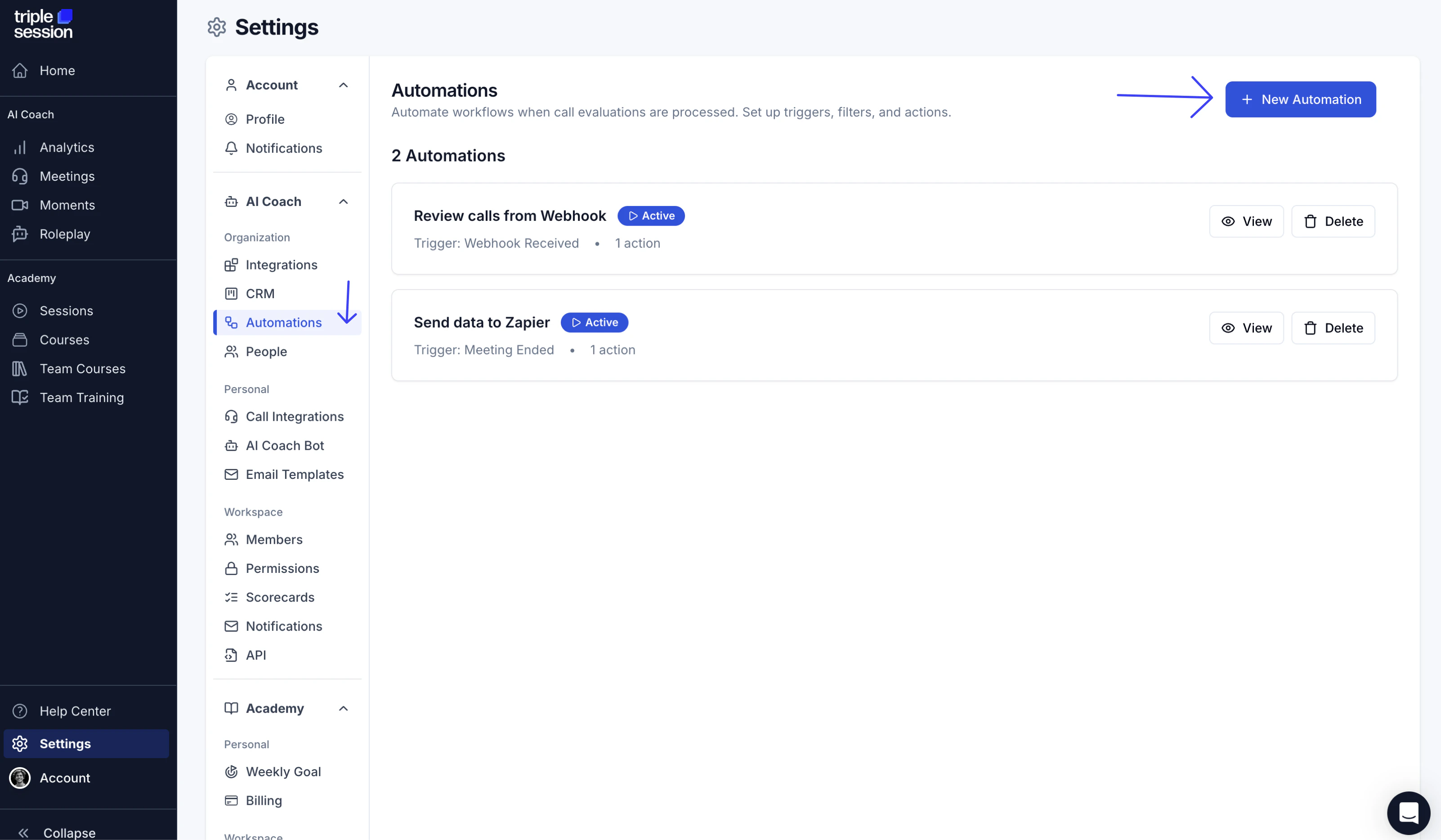
2
Configure the automation
Create an automation using the Webhook Received trigger connected to the Review Meeting action.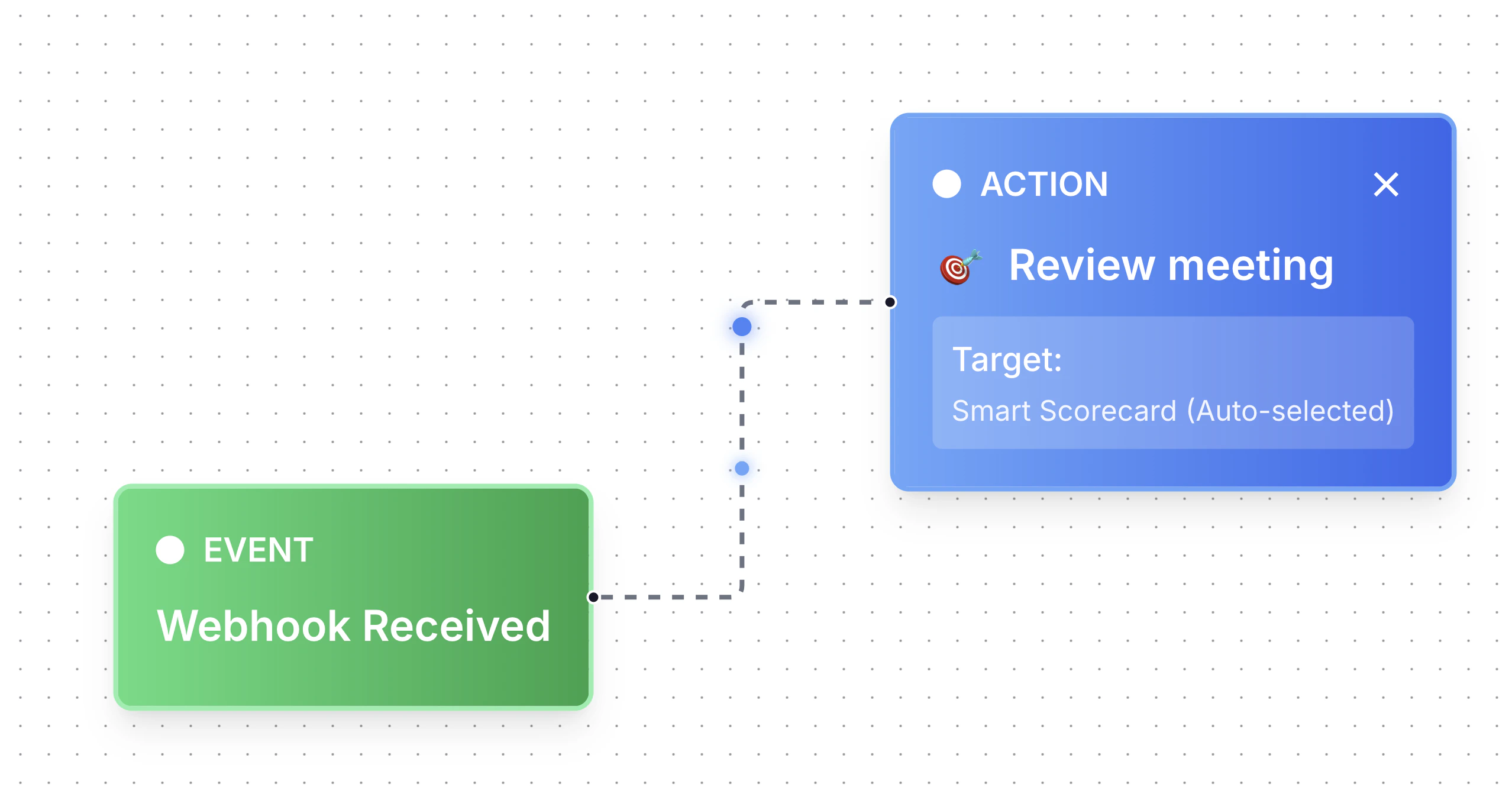
3
Copy the webhook credentials
Open the trigger. Copy the Webhook URL, the Webhook secret, and the values in Headers to send. With Signed or API key selected, send the secret in the 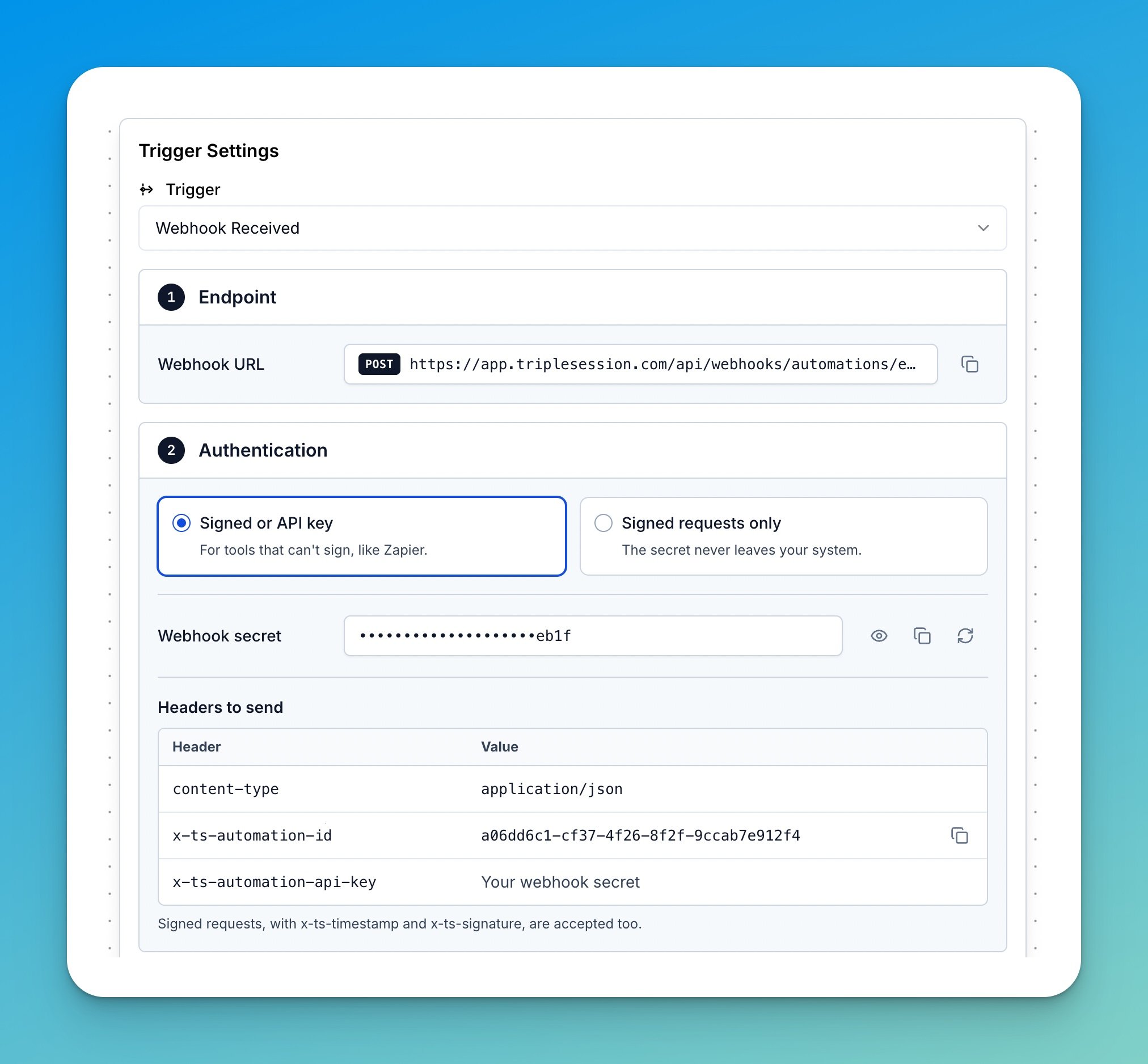
x-ts-automation-api-key header. Paste these into your automation tool (such as Zapier) to authenticate requests.Webhook payload schema
The automation webhook expects a JSON payload (content-type: application/json) with the following structure.
Form-encoded bodies (application/x-www-form-urlencoded) are also accepted for the plain text and number fields. custom_metadata needs a JSON body.
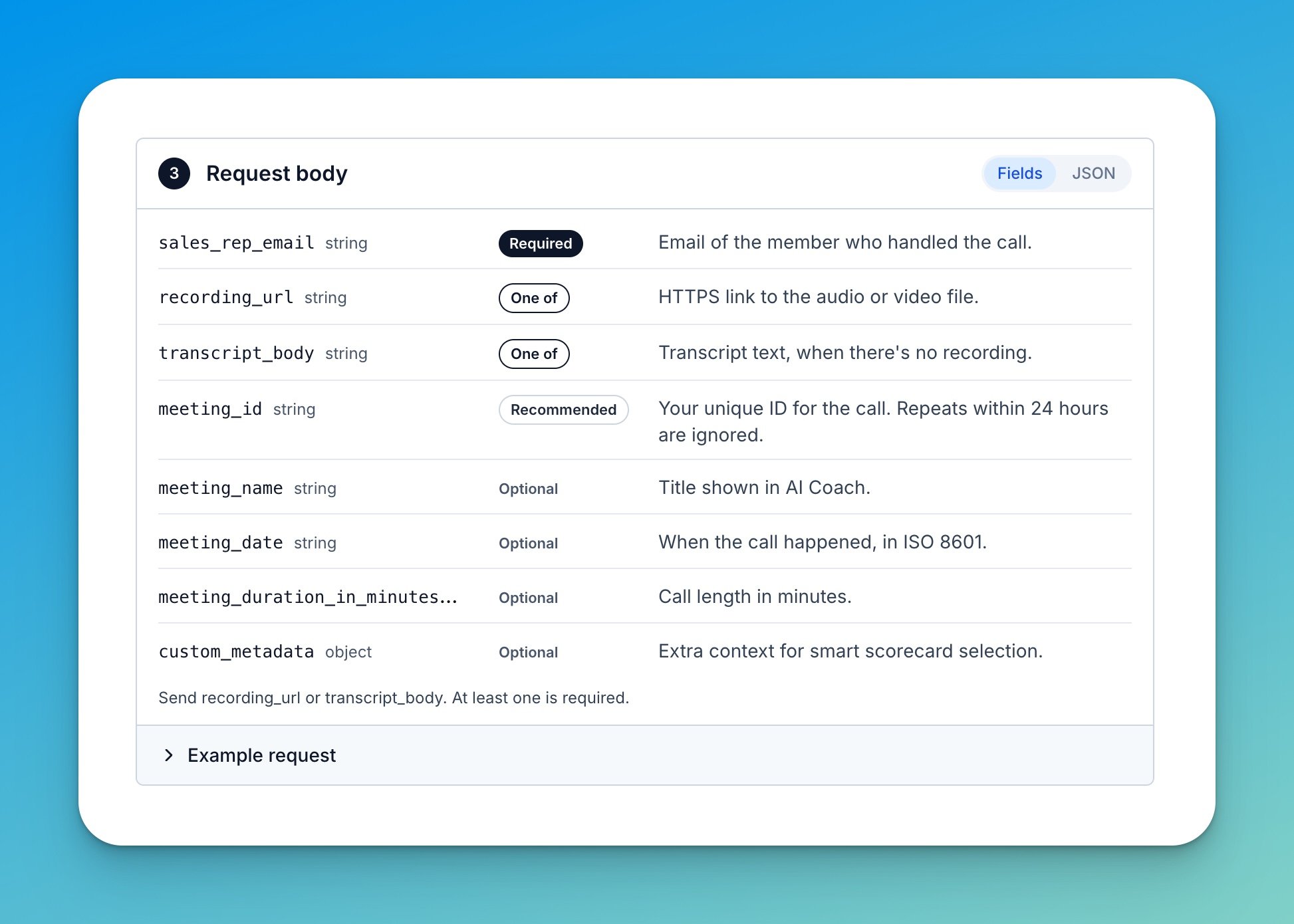
The trigger’s Request body section lists the same fields, with a JSON tab and an example request you can copy.
Required fields
sales_rep_email(string) — the email address of the sales representative. Must match a Triple Session user email in your company.
Meeting content
Provide at least one of these fields:transcript_body(string) — the full transcript content of the meeting.recording_url(string) — thehttp(s)URL of the recording inmp4,mp3,m4a, orwavformat. It can be a public link or a file on a Recording source protected by a credential.
Optional fields
meeting_id(string) — unique identifier for the meeting. Strongly recommended to prevent duplicate reviews.meeting_name(string) — name or title of the meeting. If omitted, AI Coach generates a name automatically.meeting_date(string) — original meeting date.meeting_duration_in_minutes(number) — duration of the meeting in minutes.custom_metadata(object) — optional JSON object with context from your external system. Use it to send routing hints such as call type, CRM object type, direction, stage, pipeline, or source platform.
Meeting date examples
Send a date-only value when you only know the meeting’s calendar date:Z when you already have the exact UTC time:
2026-06-20T15:30:00.
Custom metadata
Usecustom_metadata when the source platform knows context that is not obvious from the transcript or recording. For example, you can send whether the call was a demo, renewal, discovery call, or outbound conversation.
When the Review Meeting action uses smart scorecard selection, AI Coach uses this metadata as extra context to choose the best matching scorecard. If the action uses a fixed scorecard, the metadata is accepted but does not change scorecard selection.
The value must be a JSON object. Keep it concise. Triple Session accepts up to 10,000 characters after the metadata object is serialized.
Example payload
Authenticate requests
Every request sends two headers with values from the trigger’s Headers to send:
This works with any tool that can set fixed headers, such as Zapier.
If your own code sends the requests and your security policy doesn’t allow a shared secret in request headers, you can sign each request instead. See Signed requests.
Recordings behind authentication
By default, Recording source authentication on the Review Meeting action is set to None, and Triple Session downloadsrecording_url without credentials. A public or pre-signed link works as is.
If your recordings aren’t public, Triple Session can download each file with a Basic, Bearer or API key credential that your admin enters in the action. See Recordings behind authentication for setup, the Recording source contract and how the credential is protected.
Response codes
Additional notes
- The
sales_rep_emailmust match a Triple Session user email that belongs to your company. - Sending a value in
meeting_idis strongly recommended — it prevents duplicate reviews and adds idempotency to the endpoint. The samemeeting_idis accepted once per 24 hours. - If a request returns
200but no run appears in the automation’s Logs, thesales_rep_emaildoesn’t match a member of your company. - The transcript body must be a string in the
transcript_bodyfield. VTT format is recommended for the best accuracy. - The recording URL must point to a publicly downloadable file, or to a Recording source protected by a credential you enter in the automation (details). Supported formats are
mp3,mp4,m4a, andwav, up to 2 GB. custom_metadatashould contain short, structured values that help classify the meeting. Don’t send full transcripts, recordings, or large notes in this field.
Download transcripts from supported platforms
If you need to export transcripts from Zoom or Fireflies to upload manually, follow these steps.Download a transcript from Zoom
1
Go to Recordings in your Zoom account
Visit the recordings section of your Zoom account to find all available cloud recordings.
2
Download the recording files
Find the recording you want to analyze and click Download. This downloads all associated files, including the transcript.
3
Locate the .vtt file
Your download will include a file with a
.vtt extension. This is the transcript file AI Coach uses for analysis.4
Upload to AI Coach
Go to AI Coach, upload the
.vtt transcript file, fill out the review details (rep name and scorecard), and click Start Review.Download a transcript from Fireflies
1
Open Meetings in Fireflies
In your Fireflies account, click Meetings.
2
Select a meeting
Choose the meeting you want to export.
3
Download the transcript
From your Notepad, click Download, then select Download Transcript.
4
Choose SRT format
Select the SRT format. Enable the timestamp and speaker toggles before downloading.
5
Upload to AI Coach
In AI Coach, start a new review. Name the rep, select a scorecard, upload the SRT file, and click Start Analysis.